
In which I describe how and why I use Ancestry.com for historical research.
I’ve been using Ancestry.com for book research for the last eight years.
It’s been surprising and fantastic.
As a genealogist, I avoided it for years.
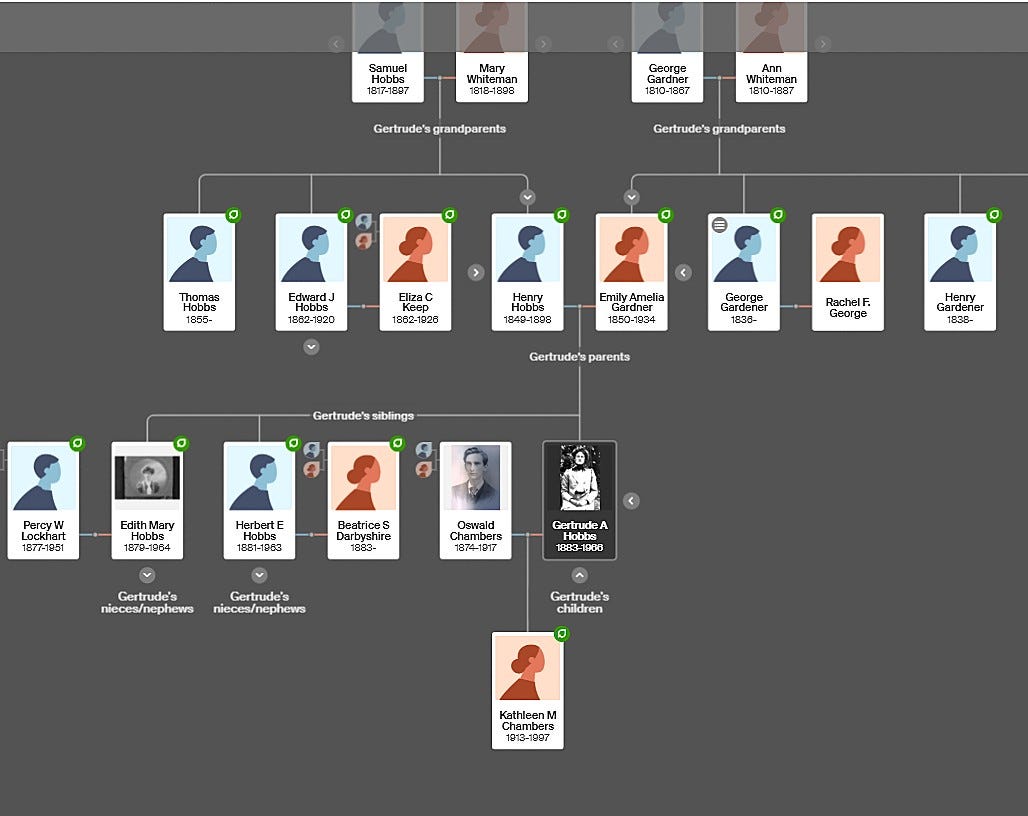
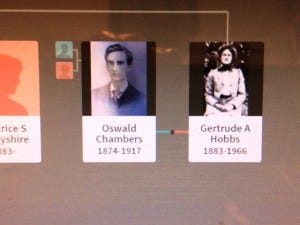
But when I began writing my biography, Mrs. Oswald Chambers, I started with one question: “Where did this woman come from?”
Ancestry.com provided the information and so much more.
English records
I live in California. I could not travel to England and do the in-depth, on-site research I’ve done on my family history.
So, I purchased a subscription to Ancestry.com.
As a genealogy “purist” who finished her research in 2000, I didn’t realize Ancestry makes primary source materials available with a mouse click.
Oh, my. It was a dream for this experienced genealogist and avid researcher.
Past experience
I’ve spent countless hours in libraries scanning book indexes, flipping pages, trying to imagine odd angles and unique names to explore.
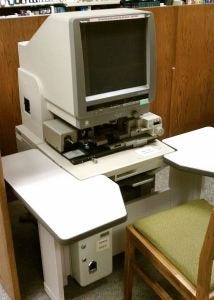
I spent hours in genealogical libraries from Washington, D.C., to Honolulu, Hawai’i, reading microfiche and microfilm.
Musty basements, brown-spotted volumes, pencils (no pens allowed in genealogical libraries), scribbled notes, and photocopies filled my days.
Sitting at my desk, examining and downloading obscure materials was incredibly easy and much less time-consuming.
Oh, my. I couldn’t believe what I turned up.
And not just about Biddy.
It’s not just family trees
Family trees are interesting and, obviously, hint at a person’s family life and relations.
Many people look at the family trees and import them into their personal lines.
However, the deep research that serious genealogists and biographers perform involves much more than a list of names.
To fully understand a person, a researcher needs a working knowledge of the times, places, and circumstances in which an individual lives.
You have to dig.
Sometimes that digging takes hours, days, weeks, or even months.
When you find a nugget, however, joy overflows.
I’ve embarrassed myself too many times in hushed libraries shouting, “Yes!” Or “Finally!”
When I did that at home, my husband might look up, but no one whispers an exasperated, “shhhh!”
Cost
I have to pay for a subscription, of course, and it’s not cheap.
But it’s one of the best uses of money I’ve spent on my writing research–and, of course, it’s a business expense.
I don't have to leave the house because I can gather this information here at my computer.
While working on my family tree, I’ve traveled long distances to use libraries in Salt Lake City, Fort Wayne, Indiana, Washington, D. C., San Francisco, and even UCLA.
I lived in Hawai’i while conducting research at the local LDS family history center, Honolulu’s central library genealogy section, and the DAR library in Manoa.
But even living locally, going to those libraries took time, energy, and coordination with my family members and babysitters.
With Ancestry.com at my fingertips, I just sit in my office and type.
It’s wonderful
The results?
I have turned up all sorts of unusual information that appears in my book.
I’ve found answers to questions that have long dogged Chambers researchers.
Ancestry.com has also been an excellent resource to track other people involved in Biddy’s life.
And it worked just as well when I researched and then wrote Lettie Cowman’s biography.


My next four Substacks will describe other unique ways I’ve used the Ancestry platform.
Meanwhile, what’s the best tool you’ve found for research?